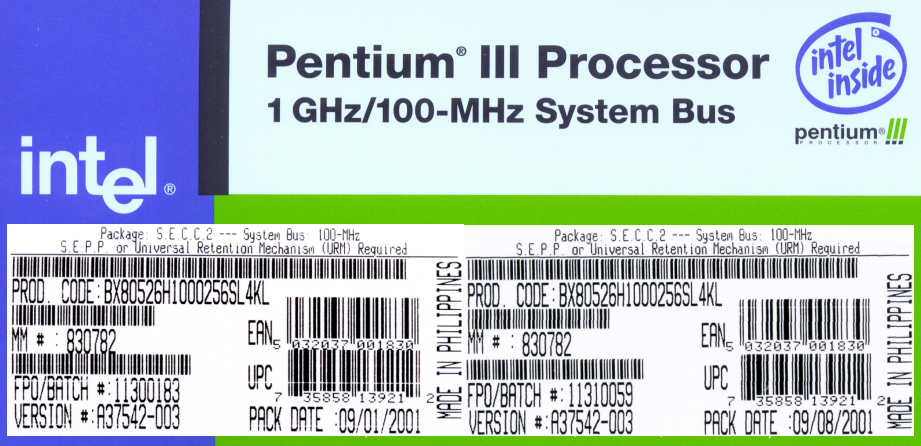
The Asus P2B-DS is one of the most stable dual processor Slot 1
motherboards ever produced. It is getting rather long in the tooth these
days (mine was purchased October 19, 1998), but can still provide impressive
performance when paired with more recent Intel processors.
Asus has continued to provide BIOS updates for the P2B-DS, allowing it to support processors which did not exist when the board was designed. BIOS version 1013 ( here ) supports Coppermine processors, while the 1014 beta 3 BIOS ( here ) supports Tutalin processors. The BIOS updates theoretically provide quite a range of PIII and Celeron processor upgrade options for the P2B-DS, however there are other issues to consider.
- Is the processor dual-capable? Many of Intel's newer processors are not.
- Form factor. Adapters are required to allow the use of PGA processors on Slot 1 boards. Not all adapters are dual-capable.
- FSB compatibility. Many of Intel's newer processors are designed for a 133Mhz system bus. The P2B-DS jumpers can be set for 133Mhz, but this will overclock the AGP bus and may cause problems with some video cards.
- CPU voltage requirements. The voltage regulators used on P2B-DS boards prior to revision 1.06 are not capable of providing CPU core voltages lower than 1.8v. Many of Intel's newer processors are designed for lower core voltages.
When these issues are taken into account, the Pentium III 1Ghz/100Mhz Slot 1 processor looks like an attractive upgrade option.
- Fully supported in BIOS 1013, no need for the beta BIOS
- The processor is dual-capable
- Slot 1 form factor, no messy adapters
- Designed for 100Mhz system bus, no need to overclock the chipset
Leaving just the CPU voltage issue - the PIII 1Ghz/100Mhz Slot 1 processor is designed for 1.7v core. This is no problem for newer P2D-DS boards (Rev 1.06 and higher) - just plug in the processors and boot up - but gives us a problem on older revision boards.
There are five voltage identification pins (named VID[0-4]) on the Slot
1 connector. These pins are used to support automatic selection of power
supply voltages. These pins are not signals, but are either an open circuit
(logic 1) or a short circuit to ground (logic 0) on the processor. The
combination of opens and shorts defines the voltage required by the processor
core. The power supply must supply the voltage that is requested or disable
itself. The table below shows the VID[0-4] logic states for 1.7v (Pentium
III 1Ghz/100Mhz Slot 1) and 1.8v (minimum available on P2B-DS rev 1.05
and lower).
| Voltage | VID0 (Pin B120) | VID1 (Pin A120) | VID2 (Pin A119) | VID3 (Pin B119) | VID4 (Pin A121) |
| 1.7 | 1 | 1 | 1 | 0 | 0 |
| 1.8 | 1 | 0 | 1 | 0 | 0 |
If we can change VID1 from a '1' (open circuit) to a '0', (short circuit to ground), the processor will appear to be requesting 1.8v. This might sound like a task requiring some delicate work with a soldering iron, however there is a better way. VID4, Pin A121, is a '0' and is adjacent to VID1, Pin A120, which we need to change to a '0'.
Slot 1 Processor VID Pins
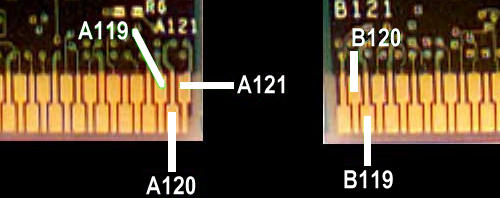
If we look closely at the Slot 1 connectors on the motherboard, there is a tiny gold contact for each pin on the processor. The contacts are spring loaded, and are forced outward when the processor is inserted into the slot. The upper ends of the contacts are visible in the small rectangular holes on the top of the Slot 1 connector, and move back and forth in these holes as the processor is inserted and removed. If we insert a small U-shaped piece of wire into the rectangular holes corresponding to pins A120 and A121, the gold contacts will be forced against the wire when the processor is inserted, thus connecting A120 to A121 and changing the processor voltage request from 1.7v to 1.8v
Slot 1 Connector VID Pins
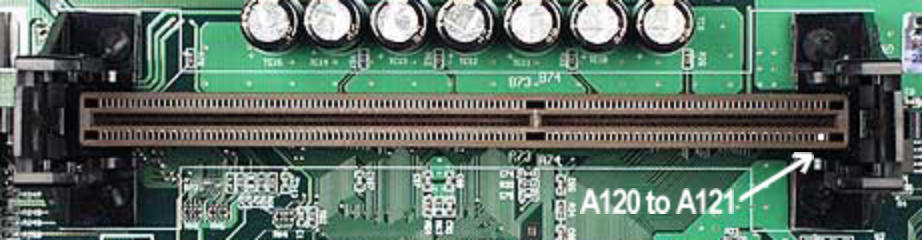
A120 and A121 are located as shown above on the Slot 1 connector
U-Shaped Wire
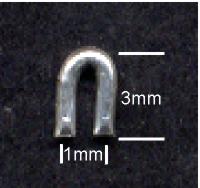
The U-shaped wire used to connect pins A120 and A121 should be about 3mm tall and 1 mm wide. It also needs to be just the right diameter. I don't have a micrometer to measure the diameter but I used the thickest wire I could find which would fit into the rectangular hole in the top of the Slot 1 connector easily. Use tweezers to drop the wire into the holes. Put wires in both Slot 1 connectors.
Now insert your processors and connect the fan cables to the headers
on the motherboard. I recommend setting the FSB jumpers for 100Mhz initially,
although my system is perfectly stable with the FSB at 112Mhz. The CPU
multiplier jumpers do not need to be set as the multiplier is locked at
10x on the Pentium III 1Ghz/100Mhz Slot 1 processor.
Processor Voltage Check
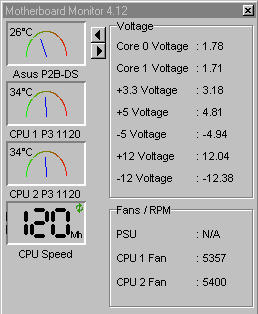
The P2B-DS BIOS does not display the core voltage for the second CPU, so I recommend booting directly into the operating system and running Motherboard Monitor to verify the processor core voltages are as expected. On my system MBM reports average core voltages of 1.78 for CPU 0 and 1.71 for CPU 1. Running the processors at these voltages does not appear to cause overheating or other problems.
I used S-spec SL4KL retail boxed processors with attached heatsink
and fan for this upgrade.